
Recent Post

Best Portable Pull Up Bar Guide: Top Picks and Buying Tips

Compact Home Gym Ideas: Space‑Saving Solutions for Every Apartment

Is whey isolate dairy free? A clear guide to understanding whey protein and dairy concerns

How to Choose Adjustable Dumbbells: A Practical Step‑by‑Step Guide

Lactose Free Whey Isolate Protein Powder: Complete Guide to Choosing, Using, and Benefits

20 minute dumbbell workout for beginners: Simple Full‑Body Routine
Laisser un commentaire

Resistance Band Exercises for Seniors PDF: A Practical Guide to Safe Strength Training
Let me be completely honest: starting a new workout routine can feel like stepping into a maze, especially when you’re looking for something gentle yet effective.
Ever caught yourself scrolling for resistance band exercises for seniors pdf and feeling overwhelmed by endless PDFs that either look way too intense or far too vague? You’re not alone. That moment of doubt – “Will this actually work for me?” – is something we’ve all been there.
Here’s the good news: resistance bands are basically the Swiss Army knife of home fitness. They’re lightweight, portable, and can be tuned to match any strength level, which makes them perfect for seniors who want to stay active without the hassle of big machines.
Imagine you’re sitting on a sturdy chair, a soft band looped around your ankles, and you’re gently pulling your legs apart. That simple movement can improve hip stability, boost circulation, and keep you moving with confidence.
And it’s not just about the legs. A quick band pull‑away for the shoulders while you’re watching TV can loosen up those tight muscles, helping you feel less stiff when you get up to answer the door.
What makes a PDF truly useful? It breaks down each exercise step‑by‑step, includes clear photos, and offers modifications so you can start low‑impact and progress at your own pace. No jargon, just plain language that feels like a friendly coach guiding you.
Think about the last time you tried a new stretch and felt a little wobble – that’s your body telling you it’s ready to grow. With the right band resistance, you’ll notice that wobble turn into steady strength.
So, what should you do next? Grab a set of beginner‑friendly bands, find a trustworthy resistance band exercises for seniors pdf, and give yourself 10 minutes a day. Consistency beats intensity every time.
By the end of this guide, you’ll have a handful of safe, effective moves you can print, stick on the fridge, and refer to whenever you need a quick, confidence‑building workout.
TL;DR
This free resistance band exercises for seniors PDF gives you simple, low‑impact moves you can print, stick on the fridge, and follow in just ten minutes a day.
Grab beginner‑friendly bands, follow the step‑by‑step guide, and watch your confidence and mobility improve without fancy equipment, right at home, starting today.
Step 1: Assess Mobility and Choose the Right Resistance Bands
Before you even think about the first band pull‑away, take a minute to check how your body feels today. Maybe you woke up a bit stiff, or perhaps you’ve been dancing around the kitchen all morning and feel loose. That moment of awareness is the secret sauce – it tells you whether you need a gentle, light‑resistance band or something with a bit more pull.
So, how do you gauge your mobility? Grab a sturdy chair, sit tall, and try sliding your hands up and down the armrests. Can you reach the top without wincing? Next, stand and do a slow hip hinge – place a hand on your thigh and see how far you can bend while keeping your back flat. If you’re comfortable moving through a comfortable range, you’re ready to pick a band. If something feels tight, start with the lightest level and let your joints warm up.
Check Your Range of Motion
Here’s a quick checklist you can print right next to your fridge:
- Shoulder circles – 10 forward, 10 back.
- Ankle flex – point and pull your toes for 15 seconds each foot.
- Standing quad stretch – hold for 20 seconds, both sides.
If you can complete these without pain, you’ve got a solid baseline. If not, consider a gentle warm‑up like marching in place for a minute before you dive in.
Pick the Right Band Tension
Resistance bands usually come in color‑coded levels: light (yellow), medium (green), heavy (blue), and extra‑heavy (black). The rule of thumb? Start light enough that you can do 12‑15 repetitions with good form, but heavy enough that the last few reps feel like a challenge.
When you’re shopping, think about the exercises you’ll be doing from the resistance band exercises for seniors pdf. For seated leg presses, a light‑to‑medium band is often perfect. For standing rows, you might need a medium‑to‑heavy band to feel the pull.
If you need a quick place to browse options, check out our strength training essentials collection – they have a variety of bands with clear resistance ratings.
Test Before You Commit
Grab the band, loop it around a stable object (like a door anchor), and perform a single rep of the move you plan to do. Does the band snap back smoothly? Does it feel too tight? If you’re unsure, you can always start with a lighter band and graduate upward as you get stronger.
Pro tip: Keep a small notebook beside your coffee mug and jot down which band you used for each exercise. Over time you’ll see a pattern – maybe you need a heavier band for shoulder pulls but stay with a light one for ankle circles.
And speaking of coffee, if you enjoy a calming sip while you stretch, you might love the vibe at Chilled Iguana Coffee Co. – they’ve got smooth blends that keep you relaxed without the jitter.
Watch the short video above for a visual guide on how to assess your hip flexibility using a resistance band. It walks you through a seated stretch that’s perfect for seniors and shows the exact band tension to start with.
Once you’ve settled on the right band, you’ll feel more confident moving on to the next steps in the PDF – the exercises will feel smoother, and you’ll notice less wobble and more control.
Looking for more inspiration on whole‑body routines? Athlemove offers a treasure trove of workout ideas that pair nicely with band training, from gentle cardio to functional strength circuits.
Finally, remember that staying active is also about staying socially engaged. If you’re new to a community or just want a friendly chat after a session, Vital Partners helps seniors connect with like‑minded companions, making your fitness journey a little less solitary.

Step 2: Warm‑Up Routines Tailored for Seniors
Alright, you’ve got the right band in hand – now let’s talk about warming up. Think of it as the coffee before you tackle a big project: it gets the blood flowing and the mind focused.
Why does a warm‑up matter for seniors? Simple: it eases joints, wakes up muscles, and reduces that “ouch” feeling when you start the main routine. A gentle warm‑up also tells you whether the band you chose feels comfortable.
Start with a seated shoulder roll
Sit tall in your sturdy chair, feet flat, hands relaxed on your thighs. Inhale, roll your shoulders up toward your ears, then exhale as you pull them back and down. Do this five times, feeling the stretch across the upper back.
Notice any tightness? That’s your cue to stay in the range that feels good, not painful. This little roll primes the rotator cuffs for the band pulls you’ll do later.
Gentle ankle circles with the band
Loop the band around one foot, keep the other foot planted, and trace slow circles with the lifted ankle. Switch direction after ten reps, then repeat on the other side.
Can you feel a mild pull without wobbling? If the band feels too tight, slide it a notch lower. This move awakens the calves and improves ankle stability for standing exercises.
So, what’s next after the ankle circles?
Hip‑hinge stretch (standing or seated)
Place the band under both feet, hold the ends at shoulder height, and hinge forward from the hips, keeping a slight bend in the knees. Let the band gently resist as you lower your torso. Hold for three breaths, then return upright.
That stretch opens the posterior chain – the muscles that support you when you stand up from a chair. If you’re using a chair, you can mimic the hinge by leaning forward just a little, still holding the band for light resistance.
Feeling a bit looser? Great. You’re ready for the main moves in the PDF.
Here’s a quick checklist to run through before you dive into the full routine:
- Band color matches your comfort level (light tug, not a yank).
- Breathing is steady – inhale to prepare, exhale to move.
- Joint pain? Scale back or swap the band for a softer one.
Now, let’s see those warm‑up steps in action.
Watch the short video above for a visual walk‑through of each warm‑up move. Pause whenever you need to match the tempo to your own pace.
After the video, try the routine twice – once just to get the motions down, and a second time to feel the gentle resistance. Keep a notebook nearby and jot down how each exercise feels. Did your shoulders feel freer? Did the ankle circles feel smoother?
Putting it all together
When you open the resistance band exercises for seniors PDF, you’ll see the warm‑up listed as the first block. Treat it as a non‑negotiable start, just like you wouldn’t skip breakfast before a big day.
Spend 5‑7 minutes on these three moves, then transition to the main strength moves. Over time, you’ll notice you need less time to get warmed up because your body remembers the pattern.
And remember, consistency beats intensity. A daily 5‑minute warm‑up sets the stage for safe, effective training and keeps you feeling confident with every band pull.
Step 3: Core Resistance Band Exercises (Video Demonstration)
Now that your joints are loosened up, it’s time to give the midsection some love. A strong core is the secret sauce that keeps you steady when you stand up from a chair, reach for the top shelf, or simply walk around the house.
And guess what? You don’t need a fancy mat or heavy weights – just the same band you’ve been using for the warm‑up. Below are three core moves that the resistance band exercises for seniors pdf highlights, plus a quick video you can pause whenever you need a breather.
1. Seated Band Dead Bug
Start seated on a sturdy chair, feet flat, band looped around both thighs just above the knees. Hold the ends of the band in each hand, elbows bent at 90°, palms facing forward.
Inhale, then exhale as you straighten one leg while simultaneously pulling the opposite arm back, keeping tension on the band. Return to start and repeat on the other side. Aim for 8‑10 reps per side.
Why this move works: it forces your abs to engage while the band provides a gentle counter‑force, protecting the lower back.
2. Supine Band Pallof Press
Lie on your back with knees bent, feet flat, and the band anchored to a sturdy object at chest height (a door knob works). Grab the band with both hands, pull it to your chest, then press straight out, resisting rotation.
Hold for two breaths, then bring it back. Do 6‑8 reps each side. This is a classic anti‑rotation exercise that builds deep core stability without any jolting motion.
Feel the subtle wobble in your torso? That’s your core firing.
3. Standing Band Anti‑Rotation (Side Pull)
Stand with feet hip‑width apart, band anchored to a pole or sturdy table on your right side. Grab the right‑hand end, step a few inches away so there’s tension, and keep your left hand on your hip.
Pull the band straight out in front of you, keeping your torso square and resisting the pull. Hold three seconds, then slowly return. Switch sides after 5‑6 reps.
These three moves hit the front, side, and deep stabilizers – the exact trio the PDF recommends for a balanced core.
So, how do you know you’re doing them right? The video below walks you through each exercise, pausing at the key points. Feel free to replay the segment where the band tension changes – that’s where the magic happens.
For a step‑by‑step visual, watch the core band demo on YouTube.
Before you jump in, a quick safety reminder: always check with your doctor before starting any new routine, especially if you have joint concerns. Montana State University’s extension guide emphasizes that resistance bands are joint‑friendly but still carry a risk if used improperly.
Here’s a handy checklist to keep beside your chair:
- Band color feels like a light tug at the start of each rep.
- Breathing: inhale to set, exhale to move.
- Core engaged – you should feel a gentle tightening, not a strain.
- No sharp pain in shoulders, lower back, or knees.
- Take a 30‑second pause between each exercise set.
Try the sequence twice: first at a slow, mindful pace to lock in form, then a second round adding a touch more tension if it still feels easy. Jot down how each move feels in your notebook – over time you’ll see the same exercises becoming smoother and more stable.
Remember, consistency beats intensity. Even five minutes of these core band moves a day will translate into steadier steps, easier chair rises, and a confidence boost that shows up in everyday tasks.
Step 4: Progression Options and Safety Checklist (Comparison Table)
Now that you’ve warmed up and tried the core moves, it’s time to think about how you’ll actually get stronger without hurting yourself.
Do you ever wonder whether you should keep using the same yellow band forever, or if it’s safe to jump straight to a red one? The answer lives in a smart progression plan that matches your daily feel.
Three‑step progression framework
We break it down into three levels – Beginner, Intermediate and Advanced – each with a specific band colour, rep range and a safety cue that tells you when to pause or step back.
Here’s how it works in plain language: start with a band that feels like a gentle tug, finish the set feeling a mild burn, and only move up when you can complete the reps without a wince.
Beginner (Light‑yellow band)
Band colour: yellow (light resistance). Ideal for shoulders, shins and the first few hip‑abductions.
Prescription: 2 sets of 10‑12 slow reps per exercise. Focus on smooth, controlled movement. If you can’t finish the last two reps without shaking, stay at this level for another week.
Safety cue: you should feel a light pull in the working muscle, but your joints stay completely pain‑free.
Intermediate (Medium‑green band)
Band colour: green (medium resistance). Great for biceps, triceps and the larger leg muscles.
Prescription: 3 sets of 8‑10 reps. Add a brief 10‑second hold at the peak of each contraction to boost time‑under‑tension.
Safety cue: a noticeable tightening in the muscle, yet you can still breathe normally and keep your spine neutral.
Advanced (Heavy‑red or blue band)
Band colour: red or blue (medium‑to‑heavy). Use only when the green band feels too easy for two consecutive workouts.
Prescription: 3‑4 sets of 6‑8 reps with a 2‑second pause at the top. Consider adding a single “challenge” set where you increase the stretch by 20 %.
Safety cue: you feel a strong resistance, but any sharp pain, especially in the lower back or knees, means you’ve gone too far.
Real‑world example: Mrs. Patel, 72, started on the yellow band for seated leg presses. After three weeks she upgraded to green, which shaved her stair‑climb time from 45 seconds to 30 seconds. Two weeks later she tried a light red for standing hip abduct‑ions and noticed her balance improving enough to walk unaided to the mailbox.
Another story: John, 68, kept his shoulder pull‑aparts on a light band for a month, then progressed to green for a “second wind” set. He reports fewer shoulder aches when reaching for the top shelf.
Safety checklist you can tape to your chair
- Band colour matches the progression level you’ve chosen.
- Inhale to set, exhale to move – no holding your breath.
- Core stays engaged; you should feel a gentle tightening, not a strain.
- No sharp pain in shoulders, lower back, hips or knees.
- Take a 30‑second pause between each set to recover.
- Write down how each set feels; look for “easy”, “moderate” or “too hard” tags.
Quick comparison table
| Progression Level | Band Colour | Reps & Sets | Key Safety Cue |
|---|---|---|---|
| Beginner | Yellow (light) | 2 × 10‑12 | Light pull, no joint pain |
| Intermediate | Green (medium) | 3 × 8‑10 + 10‑sec hold | Strong muscle tension, normal breathing |
| Advanced | Red/Blue (medium‑to‑heavy) | 3‑4 × 6‑8 + 2‑sec pause | High resistance, stop if sharp pain |
Remember, the colour‑to‑resistance relationship comes from the Theraband guide, which shows a roughly 20‑30 % jump in force between each colour at 100 % elongation. Theraband colour guide breaks it down in plain terms.
So, what should you do next? Grab the band colour that matches your current level, write down today’s numbers, and revisit the checklist after each session. If the safety cue flips to “sharp pain”, drop back a colour and repeat until the cue turns green again.
By treating progression like a conversation – “hey, I’m ready for a bit more” and listening to your body’s “no, not yet” – you’ll keep the workouts enjoyable, safe, and genuinely effective.
Step 5: Creating a Printable PDF Workout Plan
Alright, we’ve walked through the moves, the warm‑up, and how to progress. Now it’s time to turn all that good stuff into something you can actually hold in your hand – a printable PDF workout plan.
Why bother with a PDF? Because a sheet on the fridge beats a mental checklist any day, especially when you’re juggling meds, grandkids, and the occasional grocery run.
Here’s how we take the resistance band exercises for seniors PDF from idea to reality in five easy steps.
1️⃣ Gather Your Exercises
Pull together every move you’ve tried so far – the seated leg press, the shoulder pull‑apart, the hip‑hinge stretch, and any variations you like. Write down the band colour you used, the rep range, and a quick note on how it felt (“easy”, “moderate”, “too hard”). If you’ve already been jotting notes in a notebook, great – just copy them into a simple list.
Having that list in one place makes the next step painless. And if you notice a pattern, like “green band works best for upper body but yellow feels safer for hips,” you can balance the routine right then.
2️⃣ Design a Simple Layout
Open a free tool you’re comfortable with – Google Docs, Microsoft Word, or even Canva’s free PDF template. Keep the layout clean: a header with the title “Resistance Band Exercises for Seniors PDF”, a short intro reminding the reader to breathe, and then a table or bullet list for each exercise.
Columns work well: Exercise | Band Colour | Reps × Sets | Cue. Use a large, readable font (12‑14 pt) and plenty of white space so the eyes don’t get overwhelmed.
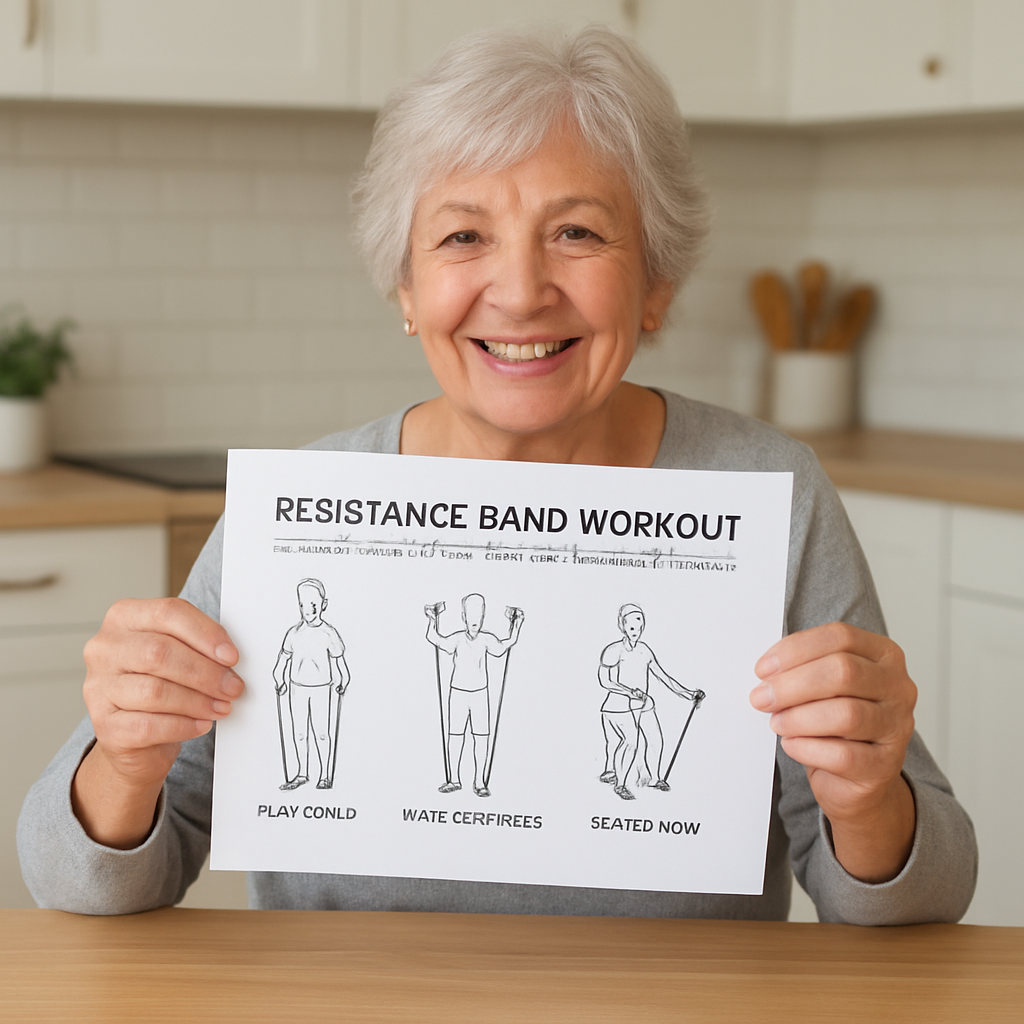
Notice the image sits between the layout tip and the next step, giving the eyes a breather.
3️⃣ Add Visuals and Safety Cues
A tiny line drawing or a royalty‑free photo next to each move does wonders. You don’t need a professional photographer – a phone snap of the band looped around the ankle, for example, is enough. Label each picture with a short safety cue like “keep knee aligned” or “avoid jerky motion.”
Because seniors love quick reference, consider a colour‑coded icon: a green check for “good to go,” a yellow exclamation for “watch form,” and a red X for “stop if pain.” This visual language turns the PDF into a conversation you can have with your own body.
4️⃣ Save, Test, and Print
When you’re happy with the layout, hit “Save as PDF.” Open the file on a phone, a tablet, and a computer to make sure the text stays crisp. Print a test page on regular paper – does it fit on a standard 8.5×11 sheet? Is the font still legible from a distance? If anything looks cramped, shrink the table or split it onto two pages.
Once the test looks good, print a few copies on slightly heavier paper (like cardstock) so the sheet can survive kitchen‑fridge life. Slip one into a clear plastic sleeve if you want extra durability.
5️⃣ Stick It Where You’ll See It
The final, and maybe most satisfying, step is to put the PDF where it matters. The fridge door, the back of a favorite chair, or even a bathroom mirror work well. Every time you see it, you get a gentle nudge to move.
And don’t forget to treat the sheet like a living document. After a week, glance at the “Cue” column – if something feels too easy, bump the band up a colour. If a note says “sharp pain,” downgrade and note the change. Updating the PDF keeps the routine fresh and safe.
So, what should you do next? Grab your favourite band set, follow these five steps, and you’ll have a custom‑made resistance band exercises for seniors PDF that’s as personal as a handwritten note and as reliable as a morning coffee.
Step 6: Tracking Progress and Staying Motivated
Alright, you’ve printed your resistance band exercises for seniors pdf and stuck it on the fridge – now comes the part most people skip: actually watching yourself improve.
Does it feel weird to write down how many reps you did or how a band felt? Trust me, it’s the secret sauce that turns a casual habit into a real habit.
Pick a simple tracking method
Grab a small notebook, a spreadsheet on your phone, or even the back of the PDF. Write the date, the band colour, the exercise, reps, and a quick “how it felt” note – for example, “light tug, no pain” or “band stretched, knees a bit shaky.”
Keep it to one line per workout. The less you have to think about it, the more likely you’ll actually fill it in.
Set micro‑goals, not big leaps
Instead of saying “I’ll do 30 reps next week,” try “I’ll add one extra rep to the seated leg press today.” Those tiny wins pile up and keep motivation humming.
And if a day feels rough, give yourself a “maintenance” goal – maybe just a 5‑minute stretch or a quick band pull‑apart. Consistency beats perfection every time.
Use visual cues for motivation
Put a sticky note on the PDF that says “3‑day streak” and update it each time you hit a day. Seeing a growing streak on paper feels surprisingly rewarding.
Or draw a simple progress bar across the top of the sheet: each workout shades in another segment. When the bar is half full, you’ll get that extra boost to keep going.
Check in with your body weekly
At the end of each week, flip to the “Cue” column you added in Step 5 and ask: “Did anything feel too easy? Too hard? Any aches?” Write a short adjustment – maybe bump the band up a shade or add a 2‑second pause at the top of the movement.
This weekly audit turns the PDF into a living document, not a static printout.
Celebrate the small victories
Did you finally do three sets of the standing hip abduction without wobbling? Give yourself a mental high‑five or treat yourself to a favorite tea. Those celebrations reinforce the behaviour loop.
Even a quick note in the margin like “felt stronger today” can be a powerful reminder when you glance at the sheet next month.
Buddy up for accountability
If you have a friend, neighbour, or even a grandchild who’s curious, share your PDF with them. Ask them to check in once a week – a quick text “How’s the band today?” can be the nudge you need on a lazy afternoon.
Sometimes just knowing someone else sees your progress makes you want to keep the streak alive.
Mix in variety to avoid boredom
Swap one exercise each week for a new band move you found online or in a senior‑friendly video. The novelty keeps the brain engaged and the muscles guessing.
Because the PDF is yours, you can shuffle the order, add a new column, or doodle a smiley next to a day you felt especially good.
When motivation dips, revisit the why
Take a moment to remember why you started: maybe it’s to climb stairs without stopping, or to play with grandchildren without getting winded. Write that reason in the margin of the PDF and glance at it whenever the band feels heavy.
Re‑reading that personal why often reignites the fire.
So, what should you do right now? Grab your notebook, jot today’s band colour and rep count, add a quick “felt good” note, and stick a tiny star next to it. Then, every few days, glance at that star and let it remind you that progress, however small, is still progress.
With a simple tracking habit, a few micro‑goals, and a dash of celebration, your resistance band exercises for seniors pdf becomes more than a sheet – it becomes a roadmap to steady, motivated movement.
FAQ
What exactly is a "resistance band exercises for seniors pdf" and how do I get started?
Think of it as a printable cheat‑sheet that walks you through senior‑friendly moves, band colour recommendations, rep ranges, and safety cues—all in one page you can stick on the fridge. You simply print it, grab the bands that match the colour guide, and follow the step‑by‑step instructions. No app needed, just a quick glance before you begin each session.
How many times a week should I work through the PDF routine?
Most seniors find 3‑4 short sessions work best. Aim for 10‑15 minutes per day, focusing on one or two muscle groups each time. Consistency beats length, so if you miss a day, just pick up where you left off rather than trying to cram a marathon workout. Over a month you’ll notice steadier balance and less stiffness.
Do I need any other equipment besides the resistance bands?
Not really. A sturdy chair, a non‑slippery floor surface, and a printable copy of the PDF are enough. If you have a door anchor or a small table, those can make a few standing moves easier, but the PDF includes seated alternatives for anyone who prefers to stay seated. Keep a water bottle nearby and wear comfortable shoes.
What if I have knee or shoulder pain—can I still use the PDF?
Absolutely, just modify. The PDF flags each exercise with a “low‑impact” version you can swap in. For a sore knee, replace standing leg presses with seated hip abductions using a lighter band. For shoulder discomfort, do the band pull‑apart while seated and keep the range of motion shallow. Always listen to your body; if pain spikes, drop the band colour down one level.
How should I track my progress using the PDF?
Turn the margin of the printed sheet into a mini‑log. Write the date, band colour, reps completed, and a quick note like “easy” or “challenging.” After each week, glance back and look for trends—maybe the light yellow band feels like a gentle tug now, which means it’s time to step up to green. Adding a star or checkmark for “done” helps keep the streak visible.
Is it safe to follow the PDF if I have a chronic condition like arthritis?
Yes, as long as you start with the lightest band and follow the gentle warm‑up in the guide. The PDF’s safety checklist reminds you to breathe, keep a neutral spine, and stop if you feel sharp pain. It’s also wise to run the plan by your doctor or physio first; they can confirm the band tensions are appropriate for your joints.
Where can I find a printable, senior‑friendly version of the PDF?
The easiest place is the FitCore Supply website, where they host a free downloadable PDF that’s already formatted for easy printing. Just head to the “Resources” section, click the download button, and you’ll have a crisp, colour‑coded sheet ready to stick on any surface you see daily.
Conclusion
We've walked through everything from picking the right colour band to warming up, core work, progression, and even printing your own cheat‑sheet. By now you should feel confident that the resistance band exercises for seniors pdf isn’t just a document—it’s a daily companion that keeps you moving safely.
Remember the three pillars: choose a band that gives a gentle tug, log each session in the margin, and upgrade only when the last rep feels easy, not painful. Those tiny habits add up to stronger legs, steadier balance, and more confidence reaching for the top shelf.
So, what’s the next step? Grab the printable PDF from FitCore Supply, stick it on your fridge, and schedule just five minutes before breakfast. If a week goes by and the yellow band feels too light, slide up to green and note the change. That simple feedback loop turns curiosity into real progress.
Ready to make the routine a habit? Give yourself a quick “yes” right now, flip the page, and start that first set. Your future self will thank you for the extra bounce in every step.
And don’t forget—checking in with a friend or family member can boost accountability. A quick text saying “Did you do today’s band routine?” keeps the momentum going and makes the whole experience feel less lonely.